It often starts with someone else noticing. A partner says you stop breathing for a few seconds at night, then snort and start again. Or you sleep eight hours, yet wake with a headache, a dry mouth and a feeling that you have not rested at all. By mid-afternoon you struggle to stay awake in meetings, or you catch yourself nodding off at traffic lights.
These are the situations that bring people to search for sleep apnea treatment. This guide explains what is actually happening during the night, how the condition is confirmed, what the treatment options are and how to tell loud snoring that is harmless from snoring that needs investigation.
What is obstructive sleep apnea?
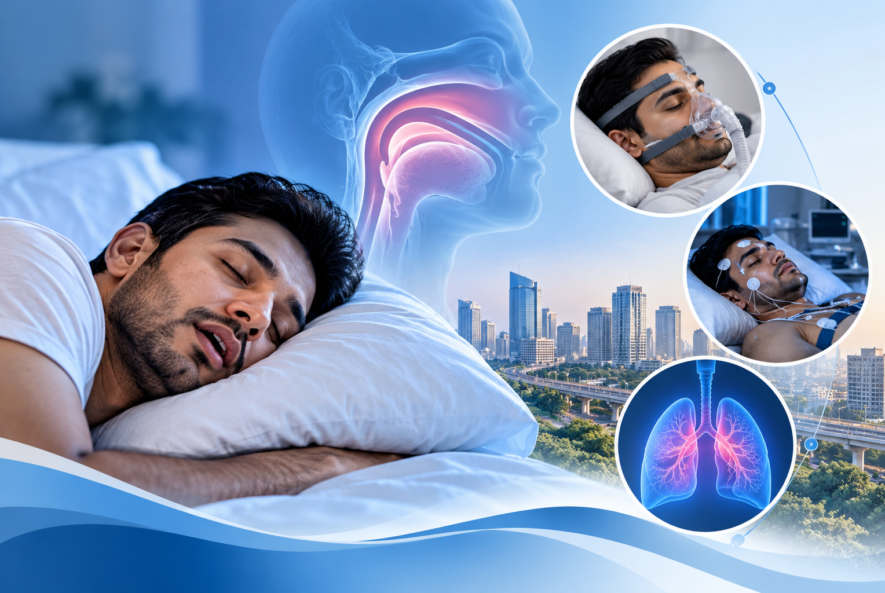
Obstructive sleep apnea (OSA) is a sleep-related breathing disorder in which the upper airway repeatedly narrows or closes during sleep. As you fall asleep, the muscles that keep the throat open relax. In people with OSA, the airway collapses partly (a hypopnea) or completely (an apnea), and airflow is reduced or stops for ten seconds or longer.
When oxygen levels drop or breathing effort rises, the brain briefly wakes the body just enough to reopen the airway. This can happen dozens of times an hour, often without you remembering any of it. The result is fragmented sleep and repeated strain on the heart and blood vessels.
Severity is usually measured with the apnea-hypopnea index (AHI), the number of breathing events per hour of sleep. In adults, roughly 5 to 15 events per hour is considered mild, 15 to 30 moderate and above 30 severe. Symptoms and oxygen levels are considered along with the number.
OSA is the most common form of sleep apnea. A less common type, central sleep apnea, occurs when the brain does not send proper signals to the breathing muscles, and it needs a different evaluation.
Sleep apnea symptoms
Some symptoms occur at night, others during the day.
At night
- Loud, habitual snoring
- Witnessed breathing pauses, gasping or choking
- Restless sleep or frequent waking
- Waking to pass urine more than once
- Night sweats or a dry mouth
During the day
- Excessive daytime sleepiness or unplanned dozing
- Morning headaches
- Poor concentration or memory
- Irritability, low mood or reduced interest in activities
- Reduced sexual desire
Not everyone with sleep apnea feels sleepy. Some, especially women, describe tiredness, insomnia-like sleep, morning headaches or low mood instead of obvious snoring.
Seek prompt medical attention if you fall asleep while driving or operating machinery, if breathing pauses are frequent, or if you have uncontrolled blood pressure, heart rhythm problems or heart failure along with these symptoms.
Is loud snoring always a sign of sleep apnea?
No. Many people snore without having sleep apnea, and snoring is very common. Snoring on its own happens when the soft tissues of the throat vibrate as air passes through. A cold, nasal allergy, alcohol before bed or sleeping on your back can all trigger it.
But snoring is the most common sign of OSA, so it should not be dismissed if it comes with other features. Get assessed if snoring is:
- Loud and habitual, most nights
- Interrupted by pauses, gasps or choking
- Accompanied by daytime sleepiness or morning headaches
- Present along with high blood pressure, obesity, diabetes or a large neck size
- Getting steadily worse
The reverse is also true. A person can have sleep apnea with relatively soft snoring. That is why diagnosis depends on a proper assessment and, in most cases, a sleep test, rather than on how loud the snoring is. If you are unsure, our page on snoring and sleep disorders explains what to look out for.
Causes and risk factors
OSA results from a combination of anatomy, body weight and the way the throat muscles behave during sleep. Established risk factors include:
- Excess weight, particularly fat around the neck and abdomen
- Male sex, although risk in women rises after menopause
- Increasing age
- A narrow upper airway: enlarged tonsils, a small or recessed jaw, a large tongue, nasal blockage or a deviated septum
- Alcohol, sedatives and sleeping tablets taken close to bedtime, which relax the airway further
- Smoking
- Family history
- Certain medical conditions: hypothyroidism, acromegaly, polycystic ovary syndrome, heart failure and kidney disease
- Sleeping on the back
OSA is not limited to people who are overweight. People of South Asian origin may develop OSA at lower body weights because of differences in facial structure and airway anatomy, so a normal BMI does not rule it out.
Why untreated sleep apnea matters
Sleep apnea is not simply a nuisance for the person next to you. Untreated moderate or severe OSA is associated with higher blood pressure that can be hard to control, heart rhythm problems such as atrial fibrillation, coronary artery disease, stroke, type 2 diabetes and fatty liver, as well as a higher risk of road traffic and workplace accidents because of sleepiness. It can also make asthma, COPD and reflux harder to manage. Treating it often improves energy, concentration and mood, and may help blood pressure control in many patients.
How is sleep apnea diagnosed?
Diagnosis is a step-by-step process, and not everyone needs the same test.
Step 1: Clinical assessment
Your doctor will ask about snoring, witnessed pauses, daytime sleepiness, driving safety, sleep habits, medicines, alcohol and other health problems. Questionnaires such as the Epworth Sleepiness Scale and the STOP-Bang screening tool help estimate sleepiness and the likelihood of OSA. The examination includes weight, neck circumference, blood pressure, and a look at the nose, mouth and throat.
Step 2: Confirming with a sleep study
Questionnaires suggest the diagnosis, but a sleep study confirms it and measures severity. There are two main types.
Laboratory sleep study (polysomnography). You sleep overnight in a sleep laboratory while sensors record brain waves, eye movements, muscle activity, heart rhythm, breathing effort, airflow and oxygen levels. This is the most comprehensive test and is usually preferred when you have other significant heart or lung disease, suspected central sleep apnea or breathing-related low oxygen during the day, neuromuscular disease, or when a simpler test is unclear. You can read what to expect on our sleep study page.
Home sleep apnea test. A simpler portable device records airflow, breathing effort and oxygen levels while you sleep in your own bed. It is suitable for selected adults who have a high likelihood of moderate to severe OSA and no major cardiopulmonary problems. If the home test is normal but suspicion remains high, a laboratory study may still be needed.
Step 3: Looking for related problems
Depending on your situation, your doctor may also check thyroid function, blood sugar, lung function, chest imaging, an ECG or echocardiogram, and ask for an ENT or dental review of the airway.
When specialist evaluation is needed
Consider seeing a sleep specialist or pulmonologist if you have loud snoring with daytime sleepiness, witnessed breathing pauses, unexplained morning headaches, resistant high blood pressure, atrial fibrillation, or if you have drowsiness while driving. Anyone whose work involves driving, flying or operating machinery and who has these symptoms should not delay.
Sleep apnea treatment options
The best option depends on severity, symptoms, anatomy, other illnesses and what you are able to use consistently. Treatment is usually combined, not a single measure.
Lifestyle and supportive measures
- Weight loss in people who are overweight can reduce the number of airway collapses and in some cases improve OSA substantially, though it does not cure it in every patient.
- Avoid alcohol and sedatives in the hours before bed.
- Positional therapy. If your events occur mainly on your back, sleeping on your side may help.
- Treat nasal blockage from allergy or sinus disease.
- Stop smoking.
- Keep a regular sleep schedule and allow enough time in bed.
These measures support medical treatment and are valuable in mild disease, but they should not be used as a substitute when a sleep study shows moderate or severe OSA.
CPAP therapy
Continuous positive airway pressure (CPAP) is the first-line treatment for most people with moderate to severe OSA and for symptomatic mild disease. A small machine delivers gentle air pressure through a mask, which acts as an air splint and keeps the throat open through the night. It is not a ventilator and does not breathe for you.
Some machines adjust pressure automatically (auto-CPAP), while others use two pressure levels (bilevel or BiPAP), which may be advised for specific patients. Getting the best results usually depends on:
- A properly fitted mask and the correct pressure setting
- Humidification for dryness or nasal congestion
- Gradual adaptation during the first few weeks
- Follow-up of machine data to check usage and leaks
- Regular cleaning and replacement of mask parts
CPAP works only when it is used. A common guide is use on most nights for at least four hours, but more is better. Many early difficulties, such as mask leaks, claustrophobia, a dry nose or noise, can be solved with adjustments, so do not stop on your own. Tell your doctor what is bothering you.
Oral appliances where appropriate
A custom-made mandibular advancement device, fitted by a trained dentist, moves the lower jaw forward slightly to widen the airway. It may be considered for mild to moderate OSA, or for people who cannot tolerate CPAP. It is generally less effective than CPAP in severe disease, and it needs dental assessment and follow-up. Over-the-counter devices are not a reliable substitute.
Surgery and other procedures
Surgery is considered for selected patients, usually when a specific correctable problem exists or when other treatments have not worked. Options include:
- Correction of nasal obstruction or removal of enlarged tonsils
- Upper airway surgery such as palate or tongue-base procedures
- Jaw advancement surgery in people with certain skeletal features
- Hypoglossal nerve stimulation in carefully selected patients, where available
- Bariatric (weight-loss) surgery in people with severe obesity
The results of upper airway surgery are less predictable than CPAP, so a careful pre-operative assessment is important. In some countries, certain weight-loss medicines have also been approved for adults with obesity and OSA, which is a topic to discuss with your doctor rather than start on your own.
Treating coexisting conditions
OSA often coexists with high blood pressure, diabetes, reflux, asthma and COPD. When OSA and COPD occur together, it is sometimes called overlap syndrome, and treatment needs careful planning because the combination can lower oxygen levels more than either condition alone. Managing all conditions together gives better results than treating each in isolation.
Follow-up and monitoring
OSA is a long-term condition. After starting treatment, follow-up typically checks symptom improvement, machine data and mask comfort, weight, blood pressure and whether the treatment is controlling the breathing events. Changes in weight, new medicines or ageing can alter your needs, so reviews should continue periodically.
When hospitalisation may be necessary
Most people with OSA are treated as outpatients. Admission may be needed for those with severe daytime respiratory failure, high carbon dioxide levels (as in obesity hypoventilation syndrome), acute heart failure or heart rhythm disturbances, or for supervised ventilation set-up and surgery planning.
Sleep apnea care in Gurgaon and Delhi/Dwarka
If you are searching for a sleep apnea specialist in Gurgaon or a sleep apnea specialist in Delhi, a few practical questions can help you choose well.
- Who will interpret the study? Sleep study results need to be read in the context of your symptoms, not only by software.
- Is a home test or a laboratory study more suitable for you? The choice depends on your health, not convenience alone.
- What happens after diagnosis? Ask whether mask fitting, pressure titration, machine data review and follow-up are part of the plan.
- Is the doctor trained in respiratory and sleep medicine? OSA overlaps with lung, heart and metabolic disease.
- How easy is regular follow-up? CPAP adherence is often best in the first few months, when review visits are important.
Dr. Shivanshu Raj Goyal is Director & Unit Head – Pulmonology, Respiratory & Sleep Medicine at Max Healthcare, Gurgaon & Dwarka, Delhi. Patients who prefer West Delhi can see the details for a pulmonologist in Dwarka, and those in Gurugram can read about consultation with a pulmonologist in Gurgaon. When booking, check which sleep testing options are currently offered at the location you choose.
Before your visit, ask a family member to note how you sleep (snoring, pauses, restlessness), bring a list of your medicines, and write down how often you feel sleepy during the day. If you drive for work, tell the doctor.
Why personalised treatment matters
One person with moderate OSA may have enlarged tonsils and nasal blockage and respond well to treating those, while another has no obvious anatomical problem and needs CPAP. A third may have OSA with COPD or heart failure and need a more detailed study and ventilation strategy. Weight, age, dental structure, sleep position, other illnesses, job demands and personal preferences all affect the choice.
The same applies to the machine itself: pressure settings, mask style and humidification vary from person to person. A device copied from a friend or bought online without a proper assessment may not suit you and can delay effective treatment.
Prevention and long-term management
Not every case of sleep apnea can be prevented, but its severity can often be reduced and complications limited. Practical, evidence-based steps:
- Maintain a healthy weight, or lose weight if you are overweight
- Limit alcohol and avoid sedatives before bedtime unless your doctor advises otherwise
- Stop smoking
- Sleep on your side if your breathing events occur on your back
- Treat nasal allergy and congestion
- Keep a consistent sleep schedule
- Use your CPAP or oral appliance every night, including during travel and naps
- Do not drive or operate machinery if you feel drowsy
- Keep regular follow-up appointments and report new symptoms
Frequently asked questions
What is the most effective treatment for sleep apnea?
For most people with moderate to severe obstructive sleep apnea, CPAP is the most effective and best-studied treatment. Mild cases or specific anatomical problems may respond to weight loss, positional therapy, an oral appliance or surgery.
Can sleep apnea be completely cured?
OSA is usually managed rather than permanently cured. In some people, significant weight loss, treatment of nasal or tonsil problems, or surgery can greatly reduce or occasionally resolve it, but it can return if the cause comes back.
What tests are needed to diagnose sleep apnea?
A clinical assessment followed by a sleep study. This is either an overnight laboratory polysomnography or, for selected patients, a home sleep apnea test.
When should I see a pulmonologist or sleep specialist?
If you have loud snoring with daytime sleepiness, witnessed pauses in breathing, morning headaches, resistant high blood pressure, atrial fibrillation, or drowsiness while driving.
Is loud snoring always a sign of sleep apnea?
No. Many people snore without sleep apnea. But snoring that is loud, frequent and combined with pauses, gasping or daytime sleepiness should be evaluated.
Can sleep apnea get worse without treatment?
It can. Weight gain, ageing and alcohol can worsen it, and untreated moderate or severe OSA is linked to higher risks of high blood pressure, heart rhythm problems, stroke and accidents.
How long does sleep apnea treatment take?
Treatment is generally long-term. Many people notice better sleep and energy within days to weeks of using CPAP regularly, but the therapy needs to continue to keep working.
Can lifestyle changes help sleep apnea?
Yes. Weight loss, avoiding alcohol and sedatives at night, side-sleeping, treating nasal congestion and stopping smoking can all help, and are often combined with other treatment.
What are the common treatments and devices?
CPAP (including auto-CPAP and bilevel machines), custom oral appliances, positional therapy, upper airway or jaw surgery in selected patients and, for some, hypoglossal nerve stimulation.
Do I need to use CPAP for life?
For many people, ongoing use is needed while OSA persists. If your weight, anatomy or other factors change substantially, your doctor may reassess with a repeat sleep study.
Can sleep apnea recur after treatment?
Yes, particularly after weight regain, if sedatives or alcohol are used heavily, or after surgery that was only partly effective. Periodic review helps detect recurrence early.
Where can I consult a pulmonologist for sleep apnea in Gurgaon or Delhi?
You can consult Dr. Shivanshu Raj Goyal, Director & Unit Head – Pulmonology, Respiratory & Sleep Medicine at Max Healthcare, Gurgaon & Dwarka, Delhi. You can book a consultation through the website.