As an advanced COPD treatment specialist in Delhi, I want every COPD patient in this city to know one thing: accepting breathlessness as inevitable is not the same as managing your disease well. There is almost always more that can be done.
What COPD Actually Is — and What It Isn’t
Chronic Obstructive Pulmonary Disease is a progressive lung condition characterised by permanent airflow obstruction — caused most commonly by long-term cigarette smoking, but also by indoor air pollution, biomass fuel exposure, occupational dust, and in some cases, untreated childhood respiratory infections.
For decades, COPD treatment has centred around inhalers, steroids, oxygen, and lifestyle changes. These remain essential — but now there are exciting new therapies that target the disease in far more precise ways.
And that is exactly what most COPD patients in India are not being told.
Why Standard Inhaler Therapy Is Often Not Enough
The vast majority of COPD patients in India are on one or two bronchodilator inhalers. When things get worse, steroids are added. When there’s an infection, antibiotics are prescribed. And then they go home and wait for the next flare-up.
This is not advanced COPD care. This is crisis management.
Patients with advanced COPD have a high symptom burden — breathlessness, cough, and fatigue are frequent daily symptoms. But guidelines and clinical practice often focus primarily on inhaler therapy, when in reality, other approaches in combination with medications offer significant additional benefit.
The problem is that COPD is not a single, uniform disease. It has different subtypes, different drivers of inflammation, and different patterns of progression. Treating every patient the same way — regardless of their specific disease phenotype — means many patients never get the treatment that would actually work best for them.
What Advanced COPD Treatment Actually Looks Like
Proper Disease Phenotyping — Finding YOUR Type of COPD
The first step in truly advanced COPD care is understanding what kind of COPD a patient has. Is it predominantly emphysema? Chronic bronchitis? Is there a significant eosinophilic (allergic-type) inflammation component? Is the patient having frequent exacerbations despite treatment?
The answers to these questions completely change the treatment approach. This is precision medicine — and it starts with a thorough evaluation, not a one-size-fits-all prescription.
Optimised Inhaler Therapy — Triple Therapy When Needed
Clinical trial evidence clearly shows that inhaled triple therapy — combining a long-acting muscarinic antagonist (LAMA), a long-acting beta-agonist (LABA), and an inhaled corticosteroid (ICS) — is more effective than dual combinations. Yet many clinicians still prescribe dual therapy, leaving patients on an undertreated regimen.
Getting the right combination of inhalers — and crucially, ensuring the patient is using them correctly — makes an enormous difference to daily symptoms and exacerbation rates.
Biologic Therapies — Targeting Inflammation at Its Root
This is genuinely exciting territory. New biologic medications like Dupixent (dupilumab) and Nucala (mepolizumab) — previously used for severe asthma — are now approved for specific COPD patients. They work by blocking key inflammatory proteins that drive swelling, mucus production, and airway wall thickening in patients whose disease is driven by eosinophilic inflammation.
The ideal candidates for biologic drugs are patients who have already maximised standard inhaled therapies and are still experiencing two, three, or more moderate-to-severe exacerbations per year — patients carrying a high symptom burden despite full compliance with their medications.
For the right patient, biologics can dramatically reduce flare-ups, improve lung function, and reduce steroid dependence.
Pulmonary Rehabilitation — The Most Underused Treatment in India
I say this every time I have the opportunity: pulmonary rehabilitation is one of the most evidence-backed, cost-effective treatments in all of COPD management — and it is almost completely ignored in Indian clinical practice.
Pulmonary rehabilitation has proven efficacy in reducing breathlessness and is recommended in international guidelines for all patients with COPD and persistent dyspnoea — its promotion alongside regular physical activity forms a cornerstone of comprehensive COPD management.
A structured programme of supervised exercise, breathing techniques, nutritional guidance, and psychological support does something no inhaler can: it rebuilds the patient’s physical capacity, confidence, and quality of life from the ground up.
Non-Invasive Ventilation (NIV/BiPAP) for Advanced Disease
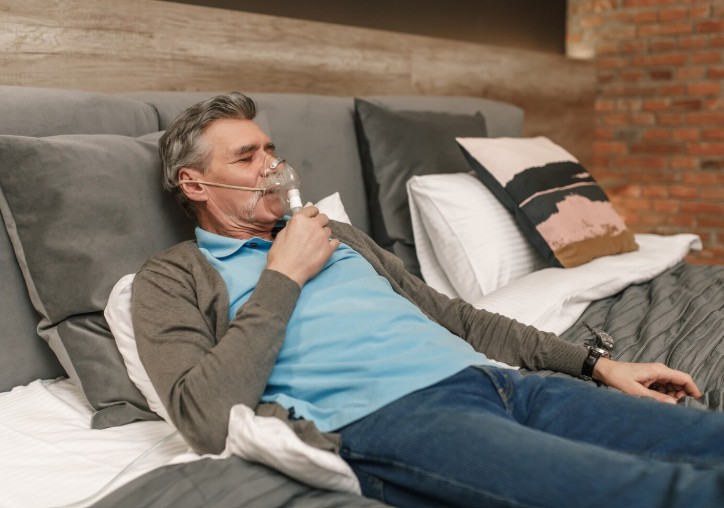
For patients with severe COPD and chronically elevated carbon dioxide levels, home non-invasive ventilation can improve survival and significantly reduce hospitalisation. NIV addresses the problem of respiratory failure in advanced COPD, helping manage the consequences of severely compromised lung function and improving quality of life when other treatments have reached their limits.
Managing COPD Alongside Other Conditions
Most COPD patients — particularly those over 55 — have other health conditions: heart disease, diabetes, depression, osteoporosis, or muscle weakness. Each of these, if unmanaged, makes COPD worse. A truly advanced COPD specialist manages the whole patient, not just the spirometry result.
The Delhi Factor: Why COPD in This City Needs Specialist Attention
Delhi’s air quality is not a background statistic for COPD patients — it is a daily clinical reality. Standard COPD medications are essential but limited — they mainly control symptoms without addressing the inflammation and tissue damage at the heart of the disease. When patients are simultaneously exposed to some of the world’s worst air pollution, that inflammatory burden is relentlessly compounded.
Managing COPD well in Delhi means building a personalised plan that accounts for seasonal pollution spikes, indoor air quality, occupational exposure, and the specific disease patterns seen in this population — many of whom have never smoked a cigarette in their lives.
A Message to Every COPD Patient Who Has Been Told “Nothing More Can Be Done”
That is not a medical conclusion. That is a gap in care. COPD is a progressive disease — but the rate of that progression, the frequency of your exacerbations, the level of breathlessness you live with every day — these are things that can be changed significantly with the right treatment.
You should not be measuring your life in how far you can walk before stopping. With advanced, personalised COPD care, most patients can do more, breathe better, and live fuller lives than they ever thought possible after their diagnosis.
FAQs: Advanced COPD Treatment — Dr. Shivanshu Raj Goyal Answers
Q1. Can COPD be cured?
Currently, COPD cannot be completely cured — but this does not mean it cannot be very effectively managed. The right treatment approach can slow disease progression significantly, reduce the frequency and severity of exacerbations, improve daily breathing comfort, and help patients lead active, fulfilling lives. The gap between “managed well” and “managed poorly” in COPD is enormous — and that gap is what advanced treatment addresses.
Q2. I’m already on two inhalers and still breathless. What else can be done?
Quite a lot, actually. The first step is a proper reassessment — are you on the right inhalers for your specific type of COPD? Are you using them correctly? Have you been evaluated for eosinophilic inflammation that might respond to biologic therapy? Have you had a structured pulmonary rehabilitation programme? Is your disease being complicated by heart disease, reflux, or obstructive sleep apnoea? Each of these questions can unlock a treatment that makes a real difference to how you feel.
Q3. Who is a candidate for biologic therapy for COPD?
Biologic therapy is most appropriate for patients who have already maximised standard inhaled therapies, are still experiencing frequent moderate-to-severe exacerbations, and have evidence of elevated eosinophil counts — indicating an immune-driven component to their disease. A blood test checking eosinophil levels is the simple starting point. If you have been hospitalised twice or more in a year despite being on triple inhaler therapy, you deserve an evaluation for biologics.
Q4. What is pulmonary rehabilitation and how do I access it in Delhi?
Pulmonary rehabilitation is a structured, supervised programme — typically running over 6–8 weeks — combining exercise training, breathing technique instruction, nutritional advice, and education about managing your condition. It is not physiotherapy alone and it is not just “going for a walk.” Done properly, it is one of the most effective interventions in COPD management. I offer a supervised pulmonary rehabilitation programme as part of my advanced COPD treatment service in Delhi.
Q5. Does air pollution in Delhi make COPD worse — and what can I do about it?
Yes, significantly. Delhi’s fine particulate matter — particularly during October to February — triggers airway inflammation and exacerbations in COPD patients. Practical steps include monitoring the Air Quality Index daily, using an N95 mask on high-pollution days, ensuring good indoor air quality, keeping rescue medication easily accessible during smog season, and having a written exacerbation action plan. I discuss all of this as part of every COPD patient’s personalised management plan.
Q6. Can COPD patients exercise?
Not only can they — they should. Exercise is one of the most powerful tools in COPD management. The fear of breathlessness leads many patients to reduce activity, which causes deconditioning, which causes more breathlessness — a vicious cycle. Supervised exercise in a pulmonary rehabilitation setting breaks that cycle safely and progressively. The goal is not to run a marathon. It is to walk to the market, play with your grandchildren, and climb a flight of stairs without your world stopping.
Q7. Why should I see Dr. Shivanshu Raj Goyal for COPD treatment in Delhi?
As an advanced COPD treatment specialist in Delhi, my approach goes well beyond prescribing inhalers. I offer comprehensive disease phenotyping, personalised inhaler optimisation, evaluation for biologic therapy candidacy, supervised pulmonary rehabilitation, NIV assessment for advanced disease, and complete management of COPD alongside comorbid conditions. My goal for every patient is simple: to help them breathe better, exacerbate less, and live more — not just survive their diagnosis.
Book a Consultation with Dr. Shivanshu Raj Goyal
If COPD has been quietly shrinking your world — your walks, your independence, your confidence — it is time to find out what advanced treatment can do for you.
Breathlessness is not your baseline. Let’s raise it.