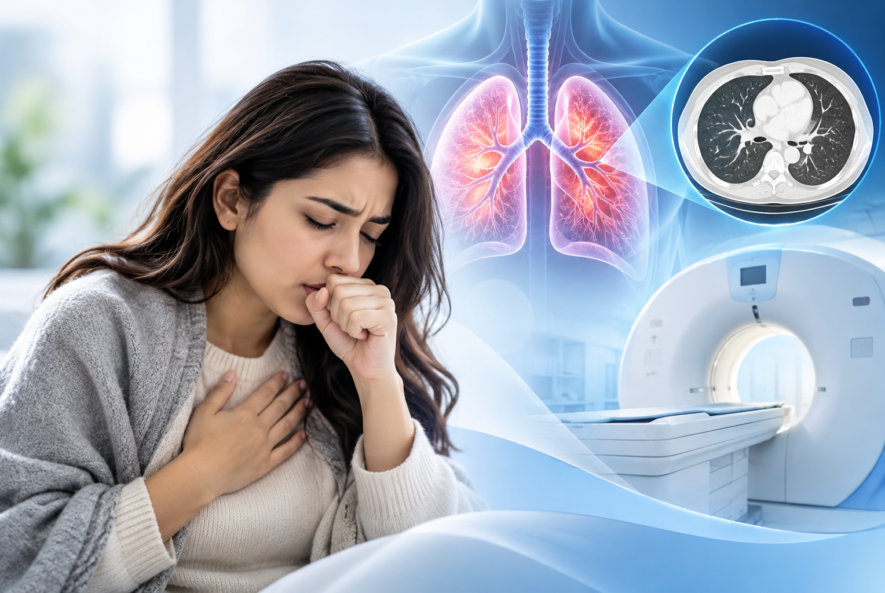
That faint whistle when you breathe may sound harmless. But sometimes, it is the first noticeable sign that your airways are struggling to move air freely.
You may notice it after climbing stairs, during a cold, while exercising, or perhaps when lying in bed at night. Sometimes it disappears on its own. Sometimes it keeps returning.
This unusual breathing sound is known as wheezing.
Rather than being a disease itself, wheezing is a symptom. It tells us that air is moving through airways that have become narrowed, inflamed, or partially obstructed.
And the reason behind that narrowing can vary considerably.
A Small Change in the Airways Can Create a Noticeable Sound
Think of the airways as a network of passages carrying air in and out of the lungs.
When these passages become narrower, airflow becomes more turbulent. That altered airflow can produce the characteristic musical or whistling sound associated with wheezing.
The narrowing may occur because of:
- Inflammation
- Excess mucus
- Muscle tightening around the airways
- Allergic reactions
- Infection
- Chronic lung disease
- An obstruction in the airway
This explains why two people with wheezing may actually have completely different underlying conditions.
For example, wheezing may occur in people with asthma, chronic obstructive pulmonary disease (COPD), or respiratory infections.
The Pattern Often Tells the Bigger Story
Wheezing does not always appear in the same way.
For some people, it occurs during exercise. For others, it becomes noticeable at night or early in the morning. It may appear during seasonal changes or after exposure to dust, smoke, pollution, or strong fragrances.
A recurring pattern may be seen in conditions such as asthma, where airway inflammation and narrowing can fluctuate over time.
Wheezing can also occur in people with chronic obstructive pulmonary disease (COPD) and during certain respiratory infections, including pneumonia.
In children, wheezing may have different causes again, which is why age and medical history are important when assessing the symptom.
What You Hear Is Only One Part of the Picture
A doctor does not diagnose the cause of wheezing simply by listening to the sound.
Other symptoms provide important context.
Wheezing accompanied by cough, chest tightness, breathlessness, or reduced exercise tolerance may point towards an airway-related problem.
If symptoms occur after exposure to an allergen, the possibility of an allergic reaction may need to be considered.
If wheezing appears during a respiratory infection and settles as the infection improves, temporary airway inflammation may be responsible.
The timing, triggers, duration, medical history, and associated symptoms all help build the clinical picture.
Why Asthma Often Comes to Mind
Asthma is one of the better-known causes of recurrent wheezing.
In asthma, the airways can become inflamed and overly sensitive. They may narrow in response to triggers such as allergens, respiratory infections, exercise, cold air, smoke, or other irritants.
Symptoms can vary considerably from one person to another and may not be present all the time.
Importantly, wheezing does not automatically mean asthma.
A proper evaluation is necessary before a diagnosis is made. Learn more about asthma care and management.
How a Doctor Finds the Cause
The evaluation usually begins with a detailed medical history and physical examination.
Your doctor may want to know:
When did the wheezing begin?
A sudden onset can have a different significance from symptoms that have been present intermittently for months.
What triggers it?
Exercise, infections, allergens, smoke, pollution, or certain environments may provide useful clues.
What other symptoms occur?
Cough, breathlessness, chest tightness, fever, or other symptoms can help narrow the possibilities.
Do you have a history of allergies, asthma, smoking, or lung disease?
Previous respiratory conditions can significantly influence the assessment.
Depending on the findings, breathing tests such as spirometry may be recommended. Additional tests or imaging may be considered when clinically appropriate.
A consultation with an experienced pulmonologist can help determine which investigations may be appropriate.
When a Whistle Becomes a Warning
Not every episode of wheezing is an emergency.
But breathing problems can become serious quickly, particularly when symptoms appear suddenly or worsen rapidly.
Immediate medical attention is important if wheezing is accompanied by severe breathlessness, difficulty speaking, blue or grey lips, severe chest tightness, confusion, fainting, or rapidly worsening symptoms.
Sudden wheezing after eating, taking a medicine, or an insect sting can also be a sign of a serious allergic reaction and requires urgent medical care.
Don’t Mask a Recurring Problem
It is tempting to treat recurring wheezing as something you simply “live with.”
But repeated symptoms can affect sleep, exercise capacity, work, and quality of life. More importantly, the underlying cause may require proper diagnosis and long-term management.
The aim of evaluation is not merely to stop the sound.
It is to understand why the airways are narrowing in the first place.
A Breath Worth Paying Attention To
Your lungs work continuously, and most of the time we barely notice the process.
That is why an unfamiliar sound while breathing deserves attention.
Wheezing can be temporary. It can be related to an infection or environmental trigger. It can also be associated with asthma, COPD, allergies, or other respiratory problems.
If wheezing is recurrent, unexplained, or accompanied by breathlessness or chest symptoms, a medical evaluation can help identify the cause and guide appropriate treatment.
Listening to your breathing may be the first step toward understanding your respiratory health.
This article is intended for general health awareness and educational purposes. It does not replace professional medical consultation, diagnosis, or treatment.
Conclusion: Don’t Ignore Recurrent Wheezing
Wheezing may seem like a minor breathing issue, but recurring episodes can sometimes indicate an underlying respiratory condition that needs medical attention. Identifying the cause can help guide appropriate treatment and support better long-term lung health.
If you experience persistent or unexplained wheezing, repeated coughing, chest tightness, or breathlessness, consult a qualified respiratory specialist instead of relying on self-diagnosis or self-medication.
Experiencing Wheezing or Breathing Difficulties? Consult a Pulmonologist
Dr. Shivanshu Raj Goyal specialises in respiratory and lung health. If you are experiencing recurring wheezing or other breathing symptoms, seek professional advice to understand the possible cause and appropriate next steps.
Book a consultation: Contact Dr. Shivanshu Raj Goyal
Take the first step towards understanding your symptoms and protecting your respiratory health.